
This report requires a Basic Subscription (available at no cost).
To download this report, please log in or register.
The new supply chain
We have all heard about virtual supply chain models as the big innovative change, but that’s so 90s!!! Over the last few years, supply chains have evolved with a new model emerging. This model is enabled by a new technology foundation (web, wireless, etc.)

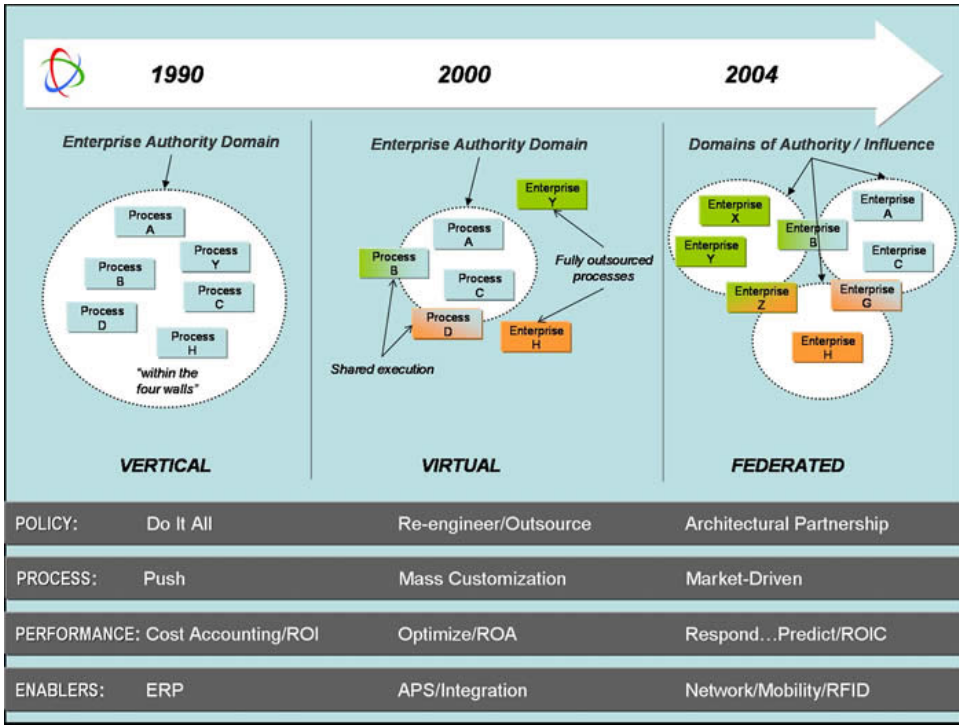
Supply Chains, to be successful, are market-driven, and as such need to be dynamic, reflecting the customer viewpoint. Virtual was an evolutionary structure born out of survival. If you look at the firms that led the way to virtual, it was all about getting cost off the books. And even today this model, first and foremost, is driven by operational goals—cost—and some operational excellence, if they can achieve it through the 3rd party partner.
In the new generation of business model, which we are calling “Federated,” responsibility is distributed, and customers now assert their value position. Customers can configure the partnerships. Federations might require new business functionality, but more important, they cannot exist without new technology structures, as well as new Delivery Architecture (more on this later). The web-based real-time architecture to run these models does not just create linkages—e—but ensures business and information synchronization—the Federation acting as one. (How this technology differs from previous models, we will discuss this shortly.)
However, it is clear that even fairly traditional business models require stronger linkages with customers, and rely on the e factor, even for fairly linear processes, like trading partner collaboration, CRM, purchasing, sales, etc. And behind firewall technology does not serve very well any time the enterprise reaches out beyond traditional boundaries.
Yet, we have not amended our approach to selecting technology as our business model, and technology needs have changed. And those win/lose quadrants tell us very little about how a particular technology can support your business goals and supply chain models.
This report requires a Basic Subscription (available at no cost).
To download this report, please log in or register.