
This report requires a Premium Subscription (available at no cost).
To download this report, please log in or register.
Results from ChainLink’s 2011 Business Priorities Survey
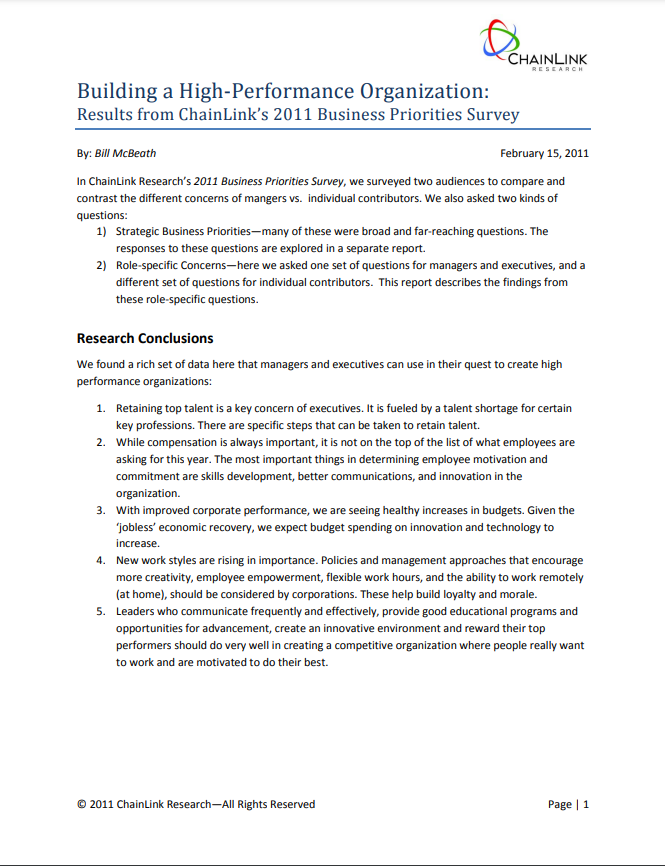
In ChainLink Research’s 2011 Business Priorities Survey, we surveyed two audiences to compare and contrast the different concerns of managers vs. individual contributors. We also asked two kinds of questions:
- Strategic Business Priorities—many of these were broad and far-reaching questions. The responses to these questions are explored in a separate report.
- Role-specific Concerns—here we asked one set of questions for managers and executives, and a different set of questions for individual contributors. This report describes the findings from these role-specific questions.
Research Conclusions
We found a rich set of data here that managers and executives can use in their quest to create high
performance organizations:
- Retaining top talent is a key concern of executives. It is fueled by a talent shortage for certain
- While compensation is always important, it is not on the top of the list of what employees are asking for this year. The most important things in determining employee motivation and commitment are skills development, better communications, and innovation in the organization.
- With improved corporate performance, we are seeing healthy increases in budgets. Given the ‘jobless’ economic recovery, we expect budget spending on innovation and technology to increase.
- New work styles are rising in importance. Policies and management approaches that encouragemore creativity, employee empowerment, flexible work hours, and the ability to work remotely (at home), should be considered by corporations. These help build loyalty and morale.
- Leaders who communicate frequently and effectively, provide good educational programs and opportunities for advancement, create an innovative environment and reward their top performers should do very well in creating a competitive organization where people really want to work and are motivated to do their best.
This report requires a Premium Subscription (available at no cost).
To download this report, please log in or register.