
If you want to grasp the picture of where we are right now, just look at the cover of the AARP Bulletin: Babies in debt, according to AARP, $156,000 in debt, to be precise. The article in AARP goes on to state that these babies could triple this debt—actually we will triple their debt for them—by the time they are fourteen.
$468,000 in debt. When I was fourteen, I had $4,000 in the bank. I had no debt, and looked forward to a scholarship to a major American University!
Third world countries put their children to work at tender ages to pay down their parent’s debt!
Like another entrepreneurial American, who started working at an early age, Ben Franklin observed, “The United States affords good laws, just and cheap government, with all the liberties, civil and religious, that reasonable men can wish for”. Mr. Franklin also said, “A penny saved, is a penny earned”. Ben died so wealthy that he still has an annuity fund today—
a non profit granting organization. Sounds like Americans need to listen to Ben. Certainly, many people around the world, outside the US do, as we discussed in the Financial Collage last month.

Better buy one of those old saying books of Ben Franklin!
Our informal survey shows that North American workers are really under the extreme crunch!
- Competition for jobs from overseas
- Decreasing wage levels
- Increasing energy costs
Our little survey had only one respondent (all working people) who had gotten a raise in the last 18 months. And with rising consumer prices—that means a shortfall in their pocket books. Hey, this could even hit Wal-Mart one day.
Henry Ford raised his workers’ pay, theorizing, correctly, that people could not buy his products if they did not get a living wage.
Economists Don’t Agree
Now, we are not advocating a raise, but at least keeping our jobs right now would be great!
But economists don’t agree on the cause, nor cure for American woes. Various research statistics are out there on demographics. This one addresses 50-year-olds and above. This was supposed to be your prime earning years, so listen up! A serious time for those approaching retirement.
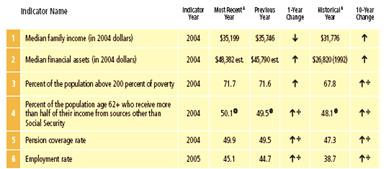

Obviously, there is a significant drop in employment as we age, but what is instructive is that people are working longer and getting paid less. And since the seniors are the biggest spenders of entertainment per capita, this can be a huge issue to a large segment of the economy.
Cruises are such a bore, anyway!
However, in the US, if one looks at, say, the Homeland Security sector (if one can call Homeland Security a market), spending is growing exceedingly well. Innovations in information technology, understanding process issues in protection and response, looks good.
Hey, want to run a port?
A blog of Buchanan uncovered this excerpt from: Our Hollow Victory by Pat Buchanan “The Bushites point proudly to 4.6 million jobs created since May 2003, a 4.7 percent unemployment rate and low inflation.”
Unfortunately, conservative columnist Paul Craig Roberts and analysts Charles McMillion and Ed Rubenstein have taken a close look at the figures and discovered that the foundation of the Bush prosperity rests on rotten timber. The entire job increase since 2001 has been in the service sector – credit intermediation, health care, social assistance, waiters, waitresses, bartenders, etc. – and state and local government.
But, from January 2001 to January 2006, the United States lost 2.9 million manufacturing jobs, 17 percent of all we had. Over the past five years, we have suffered a net loss in goods-producing jobs. “The decline in some manufacturing sectors has more in common with a country undergoing saturation bombing than with a super-economy that is ‘the envy of the world,'” writes Roberts.”
Hmmm, Pat sounds like a Democrat!
There is a huge shift in how America as a Nation spends. But one thing America insists on is taking care of their seniors. Even young people do not want to ‘touch’ social security. AARP did a survey that represented a broader set of the US demographic. You can get the full article at: http://www.aarp.org/issues/reimagining_america.html
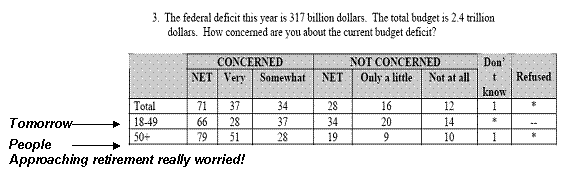
Whether or not business pays for healthcare for the society, we need to come to grips with the cost of living. Exotic pricing of houses precludes many workers from living in or near the towns where they work!
The deficit is a primary worry, and who holds the cards on that debt is an even bigger worry to our security. One critical point in this study is this key fact: “Entitlement spending is counter cyclical, rising…during economic downturns…” says another AARP study. But the financing of our programs comes from significant borrowing, and strategically more of that borrowing is from overseas, since Americans are not great savers. Total foreign ownership of the US Federal deficit currently stands at 45% as of the end of the first half of 2005…
Highlights are:
| COUNTRY | OWNERSHIP OF U.S. GOVERNMENT DEBT | |
| Japan | $687.3 | Billion |
| China | $252.2 | Billion |
| United Kingdom | $182.4 | Billion |
| Caribbean Banking Centers | $102.9 | Billion |
| Taiwan | $71.8 | Billion |
| Germany | $63.5 | Billion |
| Korea | $61.7 | Billion |
| OPEC | $54.6 | Billion |
| Hong Kong | $48.1 | Billion |
| Canada | $47.8 | Billion |
So those interest payments will go to savers/investors, not to the spenders—us!
I can hear Mao laughing now!
So what’s all this got to do with the Supply Chain?
Rambling aside, if you are an investor in an American firm or major global firm, things can look fairly good. But the investor, whose prime motive is shareholder value (a critical issue, for sure), could care less where things are made. Outsource it all—find the cheapest labour source.
House Majority Leader John Boehner, told reporters (with a straight face) that it was ok for Congressmen to take junkets from lobbyists because they ‘learned valuable information about industry’. Lobbyists drive Congress, remember, and they have time to play Golf—Supply Chain people are buried at work, too busy for golf.
Why don’t Senators tour a few factories and have cold sandwiches!
However, supply chain professionals probably understand (better than politicians) the mechanics of global trade and how we got where we are today.
Become a Leader
Markets want to be served with local content, and today, with responsiveness. The challenge for Supply Chain professionals is to demonstrate how they can achieve parity through responsiveness and lean process. You can’t have lean with inventory sitting on the ocean for six weeks.
Business Challenges and issues in the last few years have mounted up:
- Decline of major industries (steel, publishing, clothing, machine tools, automobiles, electronics, textiles, apparel, call centers, and aerospace). Now we hear that Northwest Airlines will fire their cabin and maintenance crews and replace them with foreign workers. People who use the call centers of Delta, for example, are confronted with people who don’t know how to book a fair (Great for business!!!) but they are a cheap labour source!
- Loss of good jobs. Down with manufacturing—up with burger flipping.
- Deconstructing the manufacturing and industrial companies. Thousands of companies have been sold off to foreign investors—key industries like batteries and technologies on alternative energies—hybrid, etc.
Hey, don’t we have an energy shortage?
Fast food nation!!!! Lower education and too much food might have taken the edge off our ambitions. But the argument is that the ones who play computer games are smarter—really? Entertainment is a growing industry—we can all work on shuttle buses from the airport to the hotels taking visitors to the theme parks. (The Disney in Hong Kong is too crowded).
We can even have a new version of Survivor!
The Challenge:
In the nineties, we the Supply Chain people talked about Mass Customization, lean, etc., as the way to produce a superior, more competitive company. Prove it! We heard that cutting cycle times and replacing inventory with information was the way to supply chain success. Where are we now?
We read the book, saw the sequel.
Unfortunately, our hero is in a jam!
What will our Supply Chain professional do next? Stay tuned for the next exciting adventure in Supply Chain Challenges….
Better yet, we invite you to write your own story of Victory and share it with your peers—here in Parallax View.