
The volatility of current market conditions has created unprecedented business challenges. Currently, even the most stable household-name enterprises are under siege. Erosion of shareholder value has not been limited to failures due to accounting scandals or the poor economy. Why are some companies able to literally weather the storm, while others flounder?
In this article, I am going to provide you with some thoughts from many years of work—as an operations manager, consultant, and researcher. I see an unnecessary deterioration of competitive position for many firms due to their lack of Supply Chain expertise. What can we learn from the winners—and losers? This article advances some timeless research and special knowledge for supply chain management success in this new era.
Executive Summary
Supply Chain Management has been an art since ancient times. Famous trade lanes like the Silk Road and trade zones like Kerala State in India helped to create the world we know today. Co-mingling of cultures, ideas and goods created modern times. The Romans knew it was the secret of their success. The last 25 years, though, turned art into science. In the last few years enterprises have deployed a variety of tactics with mixed results: virtual business models, demand/pull processes, IT systems like APS (Advanced Planning and Scheduling) and ERP (Enterprise Resource Planning) systems, and ebusiness strategies, to name a few. Many business executives understand that these are all parts of the puzzle to stay in the game. But if everyone eventually does it, then where is the sustaining advantage?
What has long been missing from discussions in supply chain is how supply chain contributes to competitive differentiation of the firm. And we must engage in that dialogue, as supply chain professionals, if we want to excel in our profession as well as keep the firms we work for healthy and thriving.
For many industries the barrier to entry is not just about the product, but also about speed. There is a relationship between speed and market dominance, customer satisfaction and effective cost management of the enterprise. No matter what pride of invention may have been in the hearts of the product team, it is the Supply Chain team that get that product to market. The supply chain processes provide differentiated services to customers. And in this world of walmartisation— increasing commoditization—that’s important! And supply chain is greater than that one enterprise. In fact we know that corporate reputations are made on the basis of supply chain. The reality is that products and processes are developed and executed by a whole chain of trading partners internal and external to the enterprise. So market value is also dependent on trading partners—i.e. the supply chain. And the supply chain, like bringing winning products to market, is about orchestration. And in a fast tempo! The winning virtuosos in business today are the masters of speed—speed to market, supply chain speed and most importantly decision-making speed.
The business press through the years has been peppered with stories about company losses—and gains—which at their core were about supply chain effectiveness. Late to market, supply shortages, etc.
So, the focus on supply chain is not just for the supply chain professional—but the CEO. My cause of late, which quite frankly, I have had some success at, is to create a shared language between the CEO and the supply chain professional. The CEO, who sees the supply chain as a key determinant of competitive success, is the CEO who sits on top of a leading enterprise in their sector!
Obviously there are several levers the CEO must manage to make it to the top, but in today’s virtual global world, Supply Chain Management is the key. And increasing velocity—getting to real-time—unlocks supply chain excellence.
High velocity real-time processes affect all aspects of the enterprise—your 3Pe-Policy, Process, Performance and Enablers. In this article, we will explore what it takes to be the master of speed across your 3Pe’s, in today’s economy. We will begin by making a case for real-time business management; then discuss the key organizational issue, the aligning of CEO with Supply Chain Manager; also critical is the core enabler for the enterprise, the IT systems, so we will discuss the emergence of a new supply chain systems space; and then most critically, how to align the organization around performance—we call a Decision Making Architecture.
Welcome to the 21st Century Supply Chain!
The Case for Real-time—The Vision
Over the last few years, firms have scaled back their capital investments—the swing from broad access to capital for major investments, focusing on the creation of new business models, eCommerce, acquisitions, etc.—and have shifted to outsourcing and liability controls (Sarbanes/Oxley). Outsourcing is a tactical act to increase corporate performance— shareholder value and profit.
Many firms feel under siege. Many brands are under siege. Traditional models are under scrutiny. Yet, when we look at basic processes and practices in supply chain, IT and innovation, most firms are way behind on best practice implementations. When concepts like real-time come up, executives recoil. But when queried about many operational challenges, time keeps cropping up as the key obstacle in the quest for performance improvements.
Many surveys indicate many key time values that the top firms exemplify:
- Time to Market
- Cultural transformation/or process change times
- Responsiveness to customers
- Agility/policy responsiveness and change
- Superior business performance
Many supply chain professionals are frustrated by the lack of recognition of the Supply Chain Management contribution to corporate success. They feel the CEO just sees the supply chain as a cost to be outsourced! But it is clear that supply chain impacts positively—and negatively—shareholder value as well and is today’s key to differentiation!
The definition of top performance varies, since the economic drivers vary. A Dell will lead in Return on Invested Capital (ROIC) and an Apple will lead in innovation (Time to Market). But what they all have in common is speed in business execution. They also value the power of information technology in every key operation of the enterprise. They leverage their IT investments to enhance business performance, communications within the enterprise and with key trading partners, and are able to link corporate objectives to operational activities.
The impact of agility and speed surrounding the characteristics above cannot be underestimated. During the late 80s and early 90s, (the last economic slow-down), US firms and employees faced massive re-engineering and lay-offs. The firms that quickly tackled the problems arose from the mire. Compare IBM and Digital. When Lou Gerstner assumed the helm of IBM, advisors urged him to do cost and staff cuts quickly and get back to business. This he did—declaring the company direction and quickly getting the company back to work creating one of the most impressive revenue and shareholder value increases through the nineties. IBM today still leads the technology sector and is quick to adopt new technology waves like RFID.
Digital, on the other hand, stalled in indecision. Talented employees sought more creative, productive environments elsewhere. Digital lost its competitive force, customer loyalty and its crown as the leading innovative high tech company— for good. Today, many young people have not even heard of Digital Equipment Corporation—DEC—nor its technology visionary leader, Ken Olson, and the innovative firm he founded!
In recent times we have Nortel, K-Mart, Eaton’s, etc. Rich and poor alike—Toys-R-Us, FAO Schwartz, etc. who have lost their way.
Talking about time, this perspective evolves, too. Part of the problem here is the CEOs’ lack of recognition of how things have changed over the last few years—structural changes (outsourcing), customer changes, and globalization information availability in the market place etc., require new measurements—of the business, of people and of partnerships.
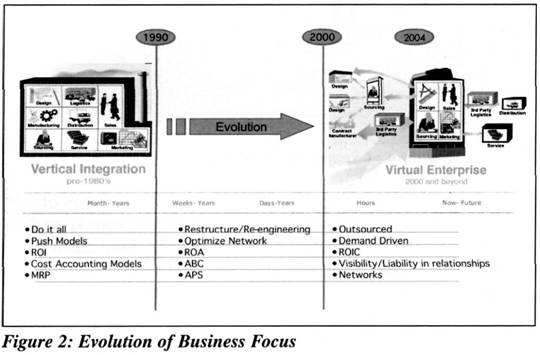
What is interesting is how few CEOs and their supply chain teams have thought about how these corporate and value chain restructures, as well as the time pressures and compressions, required them to take a new look at the performance metrics of the enterprise. In fact, very few enterprises have even given a glance to understanding that structural change also requires different systems and measurement approaches. Like Return on Assets (ROA) doesn’t make much sense if you have outsourced most of your manufacturing! ROIC, on the other hand, brings together traditional accounting approaches with supply chain velocity and blends and evolves an approach that incorporates the needs of both communities.
ISSUES FOR SENIOR MANAGEMENT
|
Firms whose focus is poor know no market category. CEOs devoid of this special knowledge miss out!
The Shift to Virtual
One thing that has to get into this discussion is the impact of outsourcing to corporate strategy.
With companies driving operation costs ever downward—everyone, though, is doing the same things. My heartfelt thought here is—so what! It’s so uncreative! It’s a race for the bottom. The search for a real competitive playground has got to go back to competitive products and services. One famous CEO was quoted as saying, ‘make the problem go away’. This firm is outsourcing all their services and their manufacturing. So much outsourcing could be the abdication of some things that, admittedly, are hard, but are truly the source of your competitive differentiation, your identity. Customers are indifferent to consultant speak—the so-called core competencies. Customers are not buying core competencies. They are buying quality products and services delivered through agility. Speed, knowledge—not cheaper—is the source of differentiation, I have heard!
Truly, firms need to think about how the source affects the brand. We have to earn the hearts—and pocketbooks—of our customers! And no thought is given, we all know it, to how customers feel about outsourcing. We are beginning to hear a great deal about how they feel—from protests at the cash register—consumers who won’t buy made-in-China (let them try!), to CNN’s declaration of war on outsourcing. The pressure must be on, since Wal-Mart has launched an unprecedented public relations campaign to mitigate the effects. But let’s not fool ourselves; these noises will not reverse this powerful trend. But firms and their customers do feel the effects of outsourcing—bad channel management (no one takes responsibility to serve the customer, etc.), for example, and frequently care about how employees are treated in the source’s factory. And they care a lot about responsiveness, across all the process areas. All these issues cost a great deal of the money to the enterprise—calls, returns, etc., which drive up manual interventions, inventories and other costs. Bad reputations occur here! Customers can accept glitches, but want the fixes fast. Connecting and finding the source of the problem is key. “Just let us know what’s happening!” is the plea of customers. They want to know that you are in control of your supply chain; and I suppose, you want to know you are too!
Time manifests across all the major business processes. Not just manufacturing alone, but product design.
So, rapid time to market—speed and agility innovation cycles and innovating new product introductions (time to market) and market sustainment (supply chain effectiveness) are key.
For example, Dell can’t get a toe-hold in the MP3 market—late arriver—vs. Apple’s 90% market share—early innovator. This very day, some firms are facing a huge crisis if these issues are not addressed.
Don’t believe it?
- 42% of the sales growth expected for the next five years will come from products introduced in that period.
- 46% of the products sold in the next ten years are as yet unknown and
- 15% of those products will be ‘new-to-the-world products’ that will create an entirely new market[1].
Consider the speed your firm works at today—how long does it take your organization to make basic decisions: open a new plant, sign on a new partner, innovate a new product—how about implementing your new IT system?
The Supply Chain Imperative
Success by many firms today has shown that there are huge benefits—both in operational efficiencies and strategic and competitive performance—by focusing on the supply chain. Today’s lost revenue should only be a minor fluctuation to those who have strong execution capabilities already in place. But of course, many do not.
Even though many have outsourced manufacturing and logistics functions, many firms still have the financial obligation and risk associated with bloated just-in-case inventories in the supply chain. This demonstrates a lack of focus on agile supply chain business models and collaborative relationships as well as poor information technology.
And poor strategic partnerships, with lack of collaboration in processes, sharing demand data, etc. means that inefficiencies will drive up the cost—passing total supply chain costs on to the customer—impacting your margins, impacting your competitive position in the market.
Firms today not only compete on product but on business models. High performance supply chains win by creating more value-competing supply chains. I see too many firms chasing ‘price per’ rather than linking inflexible, responsive and loyal relationships that will go the extra mile in challenging times.
The complexity of the supply chain, within the context of increased global competition and global opportunity, requires the enterprise to be ever more responsive to markets, customers and trading partners. Firms must think outside the four walls of their enterprise to seek competitive advantage.The advanced business model envisioned is one where the entire supply chain is synchronized from a goal and execution perspective. Partners have total supply chain visibility to design, build and deliver leading edge product to their ultimate customer—with the least use of assets. They perform a series of business functions across the entire supply chain, so that the process performs as a seamless unit.
These supply chains are characterized by a consensus of the participating partners to achieve the highest of performance —best in class, just in time, best in the world.
And in Real-time?
Supply Chain people don’t invent the products, so one of our key contributions has to be time. Customer expectations have soared ever higher—after all, we did promise it. “Our staff provides better service; we are there 24 hours a day; we take returns no questions asked; we build it to order.” Responsiveness is promised, yet we get that work done through trading partners who may be geographically distributed, and operate on different information platforms.
In the vertical business model, work is distributed across the extended enterprise, removing employees from daily business dynamics. They lose visibility as well as ability to rapidly and positively impact events. In short, there are more opportunities for glitches in the supply chain. Ironically, the major focus from a corporate perspective in the last few years has been on building information systems that support myopic information systems—inthe-box thinking—rather than extending high performance processes and rapid information across the extended enterprise—out-of-the-box thinking.
With the advent of B2B strategies, there is growing awareness to begin to focus on execution response processes and systems, external to the enterprise. This creates new opportunities for new IT platforms to flourish. We need an IT platform to allow us to link to trading partners, since they are operating our business for us.
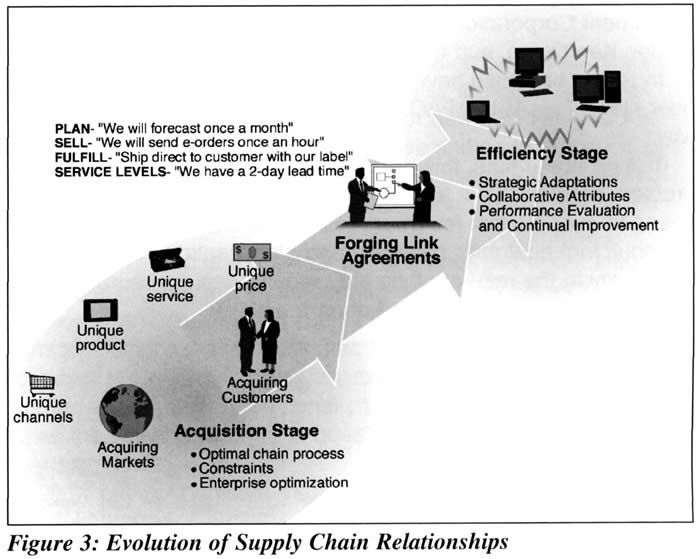
Firms do a poor job, frequently, of establishing the type of fluid partnerships—building in the evolutionary framework, as they move from market exploration, acquisition and supply chain market sustainment. Basic assumptions used to establish these frameworks are sometimes fragile, or the assumptions change. Firms need to constantly assess their ability to support the markets, and how their partnerships cleave together to support these markets. A whole thesis can be written on how these relations evolve. Suffice it to say they are built around fixed rather than fluid (real life) assumptions.
The Internet should remind people that your customers expect real-time response. Remember this concept, that there are constantly new players and new sources of information in constantly emerging markets—creating transparent processes— providing rich data on the web. Promotions, free downloads! It should give you a pause. But don’t pause too long. You can no longer afford the long, isolated architectures brought by ERR. The emerging market of the so-called Eco-Generation, the new mega-customer base, is the paradigm you should think about—instant, web, instant messaging, and peer-to-peer.
So relationships should be evolving, but how to sense these—it’s all swirling around you in very rapid time!
So, Where Do We Go, Now?
Lofty concepts, but I don’t want to just throw buzz words at you (like some so-called pundits) and not address the real challenges. There are real inherent risks, in reality, in getting to high velocity—and the limits in time space reality.
I remember a short while ago, opening a personnel requisition for Director of Warehouse systems. One candidate decided to spend his precious interview time (cut short by me after his display of his lack of knowledge about the physical reality of life) by declaring that warehouses would be defunct and everything will only be built to order. A fine thought, indeed, but the fact is that this physical world is still large and the trade lanes we use, the responsiveness we need—well, it still takes time. And we still have the laws of physics that govern the creation of our products—semiconductors take over 13 weeks, the creation of steel components for an auto—takes 180 days from iron ore to car frame, the creation of chemical blended products—paints, plastics, dyes, pharmaceutics—can take from 1 to 8 weeks.
And disruptions abound beyond time delays; there are process breaks, the weather’s bad, etc.
Markets require short response times—days. So far, the game plan is to still hedge with assets—people, plant and materials. Leaner yes, but we are still victims of the uncertainty created by the gap between market uncertainties and the expectation for certainty[2].
But we all know, of course, that hedging techniques to offset the uncertainties, such as increasing inventory, etc., have not made up the difference!
The key strategy/technology that will come to be the platform of the next decade of implementation will be the creation and implementation of the predictive networks. These techniques and systems can make up the difference, allowing the business to operate in real-time and enabling increased levels of performance. We will explore these concepts in more detail.
Align Your Processes with Your Trading Partners
No one would argue that organizations have communications problems. The lack of clarity of information, or the understanding of what to do about issues—as they are happening—causes errors and results in poor business performance. If we can be more predictive of understanding the trend line, as well as more capable of orchestrating rapid, optimal responses, the level of performance and productivity should go up.
The earlier I can understand the trend line, the more likely I can react intelligently to conditions in the making. A key difference between the masters of speed and the also-rans is this fine detection of changes in the business environment and, therefore, the prevention of major glitches. Many organizations embark upon metrics programs, which do have value, but not for daily business execution. Sadly, more IT and reporting systems usage supports the old adage of driving while looking in the rearview mirror. Large investments have recently been put into planning systems. Even firms that have rigorous planning activities have significant forecast errors and inaccurate data in their information systems. These drive errors in operational activities, resulting in excess inventory, production and shipping problems and poor customer service levels.
Anticipation is key!
Smart companies build strong alliances with their suppliers, and build flexibility into the structure. They create highly visible processes across the value chain to both serve customers and communicate changes and variability to trading partners. They jointly build response processes, evaluating scenarios, and building risk structures into these relationships.
These concepts are deployed in a few key areas:
- Demand Pull processes rapid communication of demand fluctuations through multiple layers of the supply chain
- Manufacturing Production integrated to contract manufacturers and partner plants
- Collaborative Design (which includes engineering and procurement) working with partners to introduce new competitive product and engineering changes to avoid obsolescence
- Rapid redeployment of assets and information.
It is fine to talk about real-time, but you have to focus at this process level and iron out the wrinkles. As we know, the Olympic relay is obsessively practiced to ensure that the process works. There is not speed if you drop the baton.
Without constant attention to these best-in-class processes, firms experience wrenching glitches that impact profit, reputation, and shareholder value.
The work of Vinod Singhal of Georgia Tech on supply chain performance documents and validates the relationship between poor supply chain execution capabilities and the erosion of shareholder value. Specifically, Dr. Singhal’s work showed that shareholder value drops an average of 7.52% when a supply chain glitch is announced, and that destruction of value is long term.
Value destruction starts approximately two months prior to the announcement, and value continues to decline two months after the announcement. That’s billions of dollars of real cash!
The point here is that your firm’s value is not just within your four walls, but includes forging value-creating links across the supply chain!
The Decision-Making Architecture
Running the business is a real-time experience. And when things go wrong, those events take on a life of their own. The problem will get fixed, often with disruption to daily routines. And the solution may not be as cost effective or supportive of overarching corporate goals. Very rarely do businesses simulate for these eventualities and structure a rational game plan.
Organizations also have an over reliance on several key employees who can act intuitively through years of business expertise to anticipate and propel the team to effective resolutions.
Many business opportunities or events go undetected. You don’t have the product in stock? You can’t tell your customer when you’ll have it? A major commodity price just went up and you failed to pass the cost to the retail terminal, losing critical margin. You missed a buying opportunity as key prices rose or currency valuations changed. You just missed revenue or cost saving opportunities. Clearly, many business events and decisions are not binary events, but are based on multiple dependent and related conditions that can offer opportunity—if you can respond quickly.
Setting policy direction is not usually the focus of operational staff. (See Table 1) Their marching orders are, for example, “to ship on schedule—no matter what”: Yet they are held accountable for supporting the achievement of corporate goals set by top executives who are held accountable for driving down costs. This lack of connectivity is exacerbated by the lack of decision-making processes and information systems that can harmonize these views of the business in motion.
Additionally, the lack of visibility to basic business data and deviation from normal events that drive opportunity is not made available through so-called ERP systems. They are not “market open or supply chain open” systems that support real time decision-making. An RFP from a potential customer, a spot market opportunity, or a currency or commodity drop, all create business opportunity that can only be seized with information systems that can:
- Identify these events
- Propagate business notification through the enterprise
- Support rapid and informed decision heuristics to create a performance framework
- Analyze the risk/reward associated with the decisions.
Decision-making as an art and science is not an area of focus in most firms. There are policies and procedures, but they apply to issues such as who has the signature authority, rather than the impact of decisions, nor the timeliness of those decisions.
The linkage between senior management goals and operational performance is also unsupported by the information systems that most firms have. Senior managers do not have a way to subscribe to operational information systems. Today they rely on the rear-view mirror reports or the urgent phone calls.
The decision-making architecture of the firm must then:
- Create and clarify performance goals
- Create empowerment by establishing and re-informing corporate values
- Information systems that link up the players and help align tactical events with company goals.
Timely resolution can save millions, as well as corporate reputation. Most employees don’t even know what the impact of their decisions have on the corporation or the customer.
Real-time Systems
World-class firms focus on seizing these opportunities by creating decision-making structures and information systems to support rapid decision-making.
Large IT investments have been made in the last 5 years—modernizing infrastructure systems (ERP), world class departmental functionality systems such as planning systems (APS), customer systems. In addition, ecommerce investments have linked distribution channels and customers into our enterprise processes. However, these solutions did not solve:
- Information integration between disparate data sources
- Consistency in data definitions in the enterprise, as well as across the value chain
- Coordination of business process execution
- Support for ‘need to know’ executive and employees who are not daily users of these systems
- Support for dynamic data delivery, alerting as events are in motion
- Provide ways to link, as stated before, multiple layers of the enterprise, to provide linkages and views to interpret policy and performance goals at a tactical level
- Dynamic business process management.
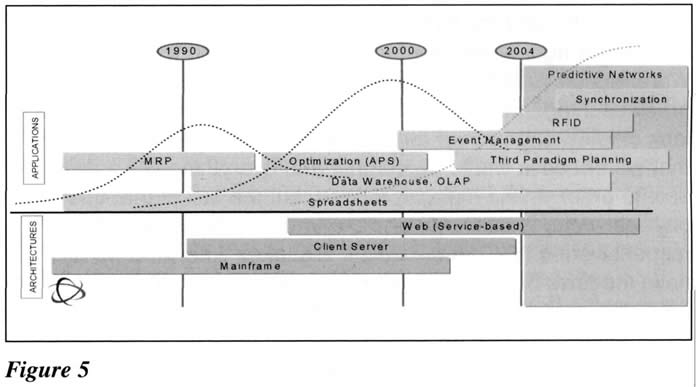
A new class of information systems is now available that can enable real-time—in fact be predictive of events. (Many organizations are starting to use the terms sense and respond). These systems operate on the latest information available to the organisation from within the four-walls or across the extended enterprise. They link multiple layers of the enterprise to their partners, regardless of what kinds of technologies are deployed. They are system agnostic, linking heterogeneous data sources to the desktop. And now, with the advent of RFID, will link assets in motion to subscribing users.
These new information systems detect and isolate casuals, identify related and dependent events and drive resolution, rather than presenting users with mountains of static reports.
In addition, they provide a richer contextual field of information for sharing more types of data and synthesizing strategy and operational activities to achieve better business performance. Being web based, they focus between the enterprises— again aligning the trading partner network, rather than internal to the enterprise[3]. This system today adds to the IT portfolio; but in the future, as more processes are outsourced, they will, in many cases, be the enabler of the process rather than using enterprise systems.
Conclusion— Manage your 3Pe’s
Embracing speed and agility, although talked about a great deal in business circles, has not been easy to adopt. A new class of software will enable the real-time supply chain.
The chasm between high performance enterprises, already far ahead at leveraging best practices in their industry, and the laggards, grows wider. So time based policies and processes have to be addressed. Firms who lead their sectors are good executors—they think less and do more. What separates these organizations in their markets is an environment of action and learning.
Put this rambling article on your executive’s desk! The linkages between Supply Chain management and corporate differentiation cannot be denied. Cash cycle times, market reputation, Return on Invested Capital, and other value metrics are all affected by Supply Chain.
And supply chain professionals should think deeply, before they propose process changes about how what they say—supply chain speak vs. corporate strategy speak—is heard, or not.
[1] Bryan A. Lukas, G. Tomas, M. Hult and Mark N. Frolick “Reducing Cycle Time in New Product Develop Processes: A Best Practice Investigation,” Cycle Time Research (1999)